Selling
Selling a Morgantown Home: Prepare the Radon Record
Organize radon tests, mitigation details, contractor records, and retesting questions before a Morgantown home reaches the market.
Last reviewed · Next source review by
A Morgantown seller does not need to turn a radon question into a last-minute scramble. Find the existing test results, identify what changed after those tests, and collect any mitigation records before the listing reaches the market. If the file is incomplete or outdated, make a testing plan with the people handling the sale.
That preparation keeps the conversation tied to one house. Radon cannot be estimated from a neighbor's result, a home style, or a map alone. A clear record lets the seller, buyer, agent, tester, and contractor work from the same dates and documents while there is still time to answer follow-up questions.
This is an organization guide, not medical, legal, inspection, disclosure, or mitigation advice. Use West Virginia's current radon program, qualified providers, and the professionals responsible for the transaction when deciding what a specific property needs.
Key takeaways
- Gather every prior test result and note where, when, and by whom the test was completed.
- Treat an older result as evidence to review, not a permanent description of the home.
- Verify West Virginia radon credentials before hiring a testing or mitigation provider.
- Keep system records, later test results, permit questions, and transaction dates in one seller file.
Start with the radon record already attached to the house
Search the home file before ordering another service. A useful prior test record should identify the test date, result, device or laboratory, test location, and person or company that handled it. Keep the complete report rather than copying one number into a note.
Then compare the report with the house today. Write down any finished lower-level space, foundation work, heating or ventilation change, addition, or other renovation completed after the test. Also note whether a future buyer could regularly use a lower level that was not included in the earlier test location.
If a mitigation system was installed, gather more than the invoice. Look for the installer's name, installation date, system drawing or scope, equipment information, warranty, service history, and test performed after the work. If one of those items is missing, label it as an open request. Do not recreate it from memory.
The broader Morgantown seller documentation guide can hold this radon file beside roof, heating, repair, permit, and warranty records.
Decide whether the old result still answers the question
The EPA tells sellers to review how an earlier test was completed before sharing it as reliable information. Its current guidance says a buyer may request another test when the testing checklist was not followed, the result is not recent, the home changed after the test, or the buyer expects to use a lower level that was not tested. The EPA gives about two years as an example of a result that may no longer feel recent in a sale.
That is guidance, not a promise that every buyer, lender, contract, or professional will treat a test the same way. Put the date and test location in front of the agent and qualified radon provider. Ask whether the existing report is useful history, whether a new test makes sense before listing, and what documentation the transaction will need.
Avoid the tempting shortcut of comparing the house with a nearby result. EPA guidance says adjacent homes can produce different indoor radon levels. Testing the specific home is the way to establish its result.
Plan a new test before the calendar gets tight
West Virginia's Radon Program says state residents may request a free test kit from the program. That can be a useful early resource, but a seller should not assume that any kit, placement, or testing schedule will satisfy a real estate transaction. The EPA has testing guidance written specifically for purchases and sales because timing and device interference matter.
Before the test begins, settle a few practical questions:
- Which level and room should be tested?
- Who will place and retrieve the device?
- What instructions apply to the house during the test?
- How will the result be delivered and shared?
- What happens if the device is moved or the required conditions change?
- Which listing, inspection, or contract date depends on the result?
If you hire a provider, use the West Virginia licensing search to check the current listing for the individual, business, or laboratory involved. The state licensing program covers radon professionals and contractors. Save the verification with the report instead of relying on an advertisement or an old business card.
Turn a mitigation system into a readable property file
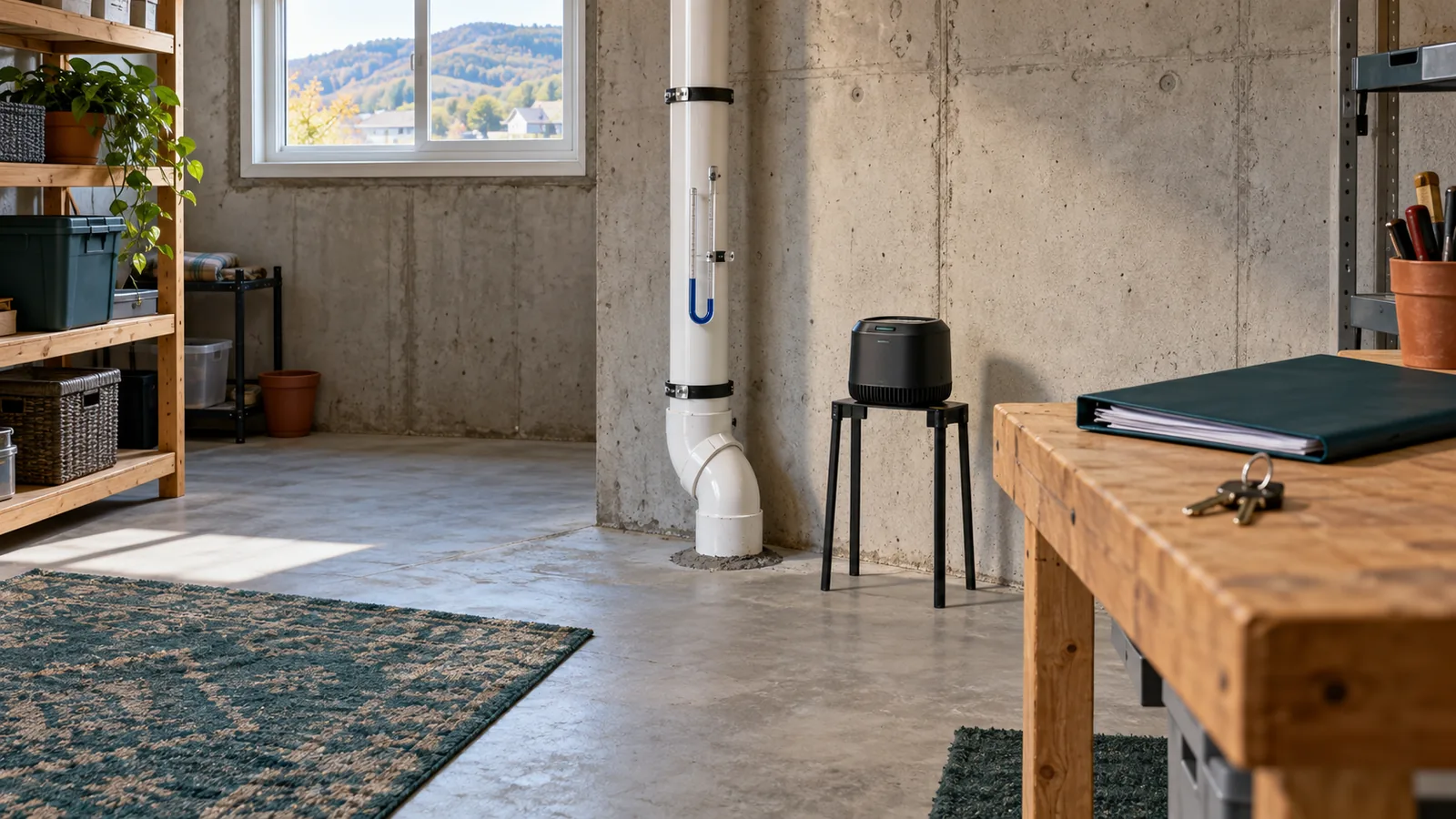
A visible pipe and pressure gauge show that equipment is present. They do not tell the whole history. The file should connect the physical system to the contractor's scope, the installation date, and testing performed after the work.
Photograph the accessible components for the working file without exposing labels that contain private contact or account information. Record where the system enters the slab or crawl area, where visible piping runs, and where electrical or service components are located. Let a licensed radon professional explain the system and any maintenance indicator. A seller should not describe a gauge reading as an indoor radon result unless the qualified provider confirms what that instrument reports.
Ask the provider whether the system needs service or another test before the sale. EPA guidance recommends testing after mitigation to confirm that radon levels were reduced, and it advises future retesting because conditions and use can change.
Check jurisdiction and permit questions separately
A Morgantown mailing address does not always mean the property is inside city limits. The City of Morgantown directs owners to its zoning viewer to confirm city-limit status and uses the Morgantown Access Portal for building and trade permit applications. The city also says separate permit types are used for separate work scopes.
Do not guess whether a past radon project required a building, electrical, or other record. Start with the address and the work that was actually completed, then ask the responsible office what record is available. A contractor invoice and a permit record answer different questions.
For property outside Morgantown city limits, identify the office responsible for that address before applying a city process. Keep any written response with the system file.
Share the record without turning it into marketing copy
The working transaction file can contain full reports, invoices, system details, and professional contacts. Public marketing usually does not need every page. Decide with the listing broker and attorney what should be provided, when it should be provided, and which statements belong in public remarks, disclosures, or a document portal.
Keep private payment details, signatures, personal email threads, and unnecessary account information out of public materials. If a record is incomplete, say what is missing. "Installation date not located" is more useful than an unsupported estimate.
Also separate the radon result from the sales pitch. A documented result or mitigation system is property information. It does not support a guarantee about future readings, health outcomes, or what another test will show.
Put the next step beside the sale timeline
Finish with a short status sheet that someone else can understand without a phone call:
- Prior test reports include dates, locations, methods, and complete results.
- Changes made after the last test are listed.
- The need and timing for a new test were reviewed.
- Current West Virginia credentials were checked for hired providers.
- Mitigation scope, equipment details, service history, and later tests are together.
- City-limit status and any permit-record questions were routed to the correct office.
- Private information was removed from public-facing copies.
- Every unresolved item has a responsible person and a transaction date.
This file will not remove every question, and it should not. It gives each question a record, an owner, and enough time for a responsible answer. If you are preparing a Morgantown property for sale, contact Michelle with the address and the radon document you already have. She can help place that item beside the rest of the listing and contract timeline.
Sources
- Radon ProgramWest Virginia Office of Environmental Health Services · Accessed October 12, 2026
- Licensing ProgramWest Virginia Office of Environmental Health Services · Accessed October 12, 2026
- Home Buyer's and Seller's Guide to RadonUnited States Environmental Protection Agency · Accessed October 12, 2026
- How Often Should I Test or Retest My Home for Radon?United States Environmental Protection Agency · Accessed October 12, 2026
- Permitting, Licensing, and RegistrationCity of Morgantown · Accessed October 12, 2026
A local next step
Make the next step feel clearer.
Michelle can help turn this guidance into a calm, property-specific plan for a first home, sale, or multifamily property in Morgantown.
Contact Michelle
About the author
Michelle Davidson
Michelle Davidson is a Morgantown native and REALTOR(R) who works with first-time home buyers and multifamily property investors. She has firsthand experience buying, selling, and owning local property.
Meet Michelle